
I Am Fully Filipino, Fully American

Homer, Lulu, Vince, Valery, and Vivien
“You’re so White, Viv.”
I heard those words as a kid way too often. From friends, neighbors, and at times, distant relatives. They didn’t say it to be mean, they were mostly joking. In their minds, they saw the color of my skin and judged it based on my likes and dislikes, the way I acted and the inflections in my voice. Each time I heard that phrase I didn’t know what to say, but I knew exactly how I felt — insignificant and unknown.
I started writing this piece 3 years ago, but I’ve struggled to complete it. Each time I tried to voice my story, I remembered those words. I felt that my story wasn’t “Filipino” enough; it didn’t feel good enough. Even writing that out makes me cringe. I dismissed my story out of guilt. I never thought I was Asian enough because I don’t know how to speak Tagalog and I never lived in the Philippines. I compared myself to other Filipinos and imagined rejection. I was confused about my ethnic identity, so I tucked this aspect of me away. I didn’t want to face any more judgements.

Until now.
October is Filipino-American History Month. Thanks to this celebration, I’ve read so many other stories and historical events from fellow FilAm (Filipino-American) voices. This month has given me a new sense of pride. This is why I share my story now. I want to help YOU see your own heritage as significant and to point out the lies that have made you feel anything less. That’s the gift I’ve received this month. My story doesn’t look like everybody else’s, but that’s what makes our personal experiences so beautiful.

Mom and Dad aka Young Nanay and Tatay
Both my parents, Homer and Lulu, are native-born Filipinos. They were born and raised in Manila. My mom’s dad (my Lolo) always wanted his kids to live America, so my mom migrated to the US in 1972 as a way to fulfill her father’s American dream. Lulu’s first stop was the Bronx in New York City. She lived and worked in the city for a time before going back to the Philippines to marry my Dad. They had known each other before she left for America. My mom had a green card at that point which helped her petition my Dad’s entry into the United States. They got married in the Philippines in 1976, and they eventually landed in Flint, Michigan.
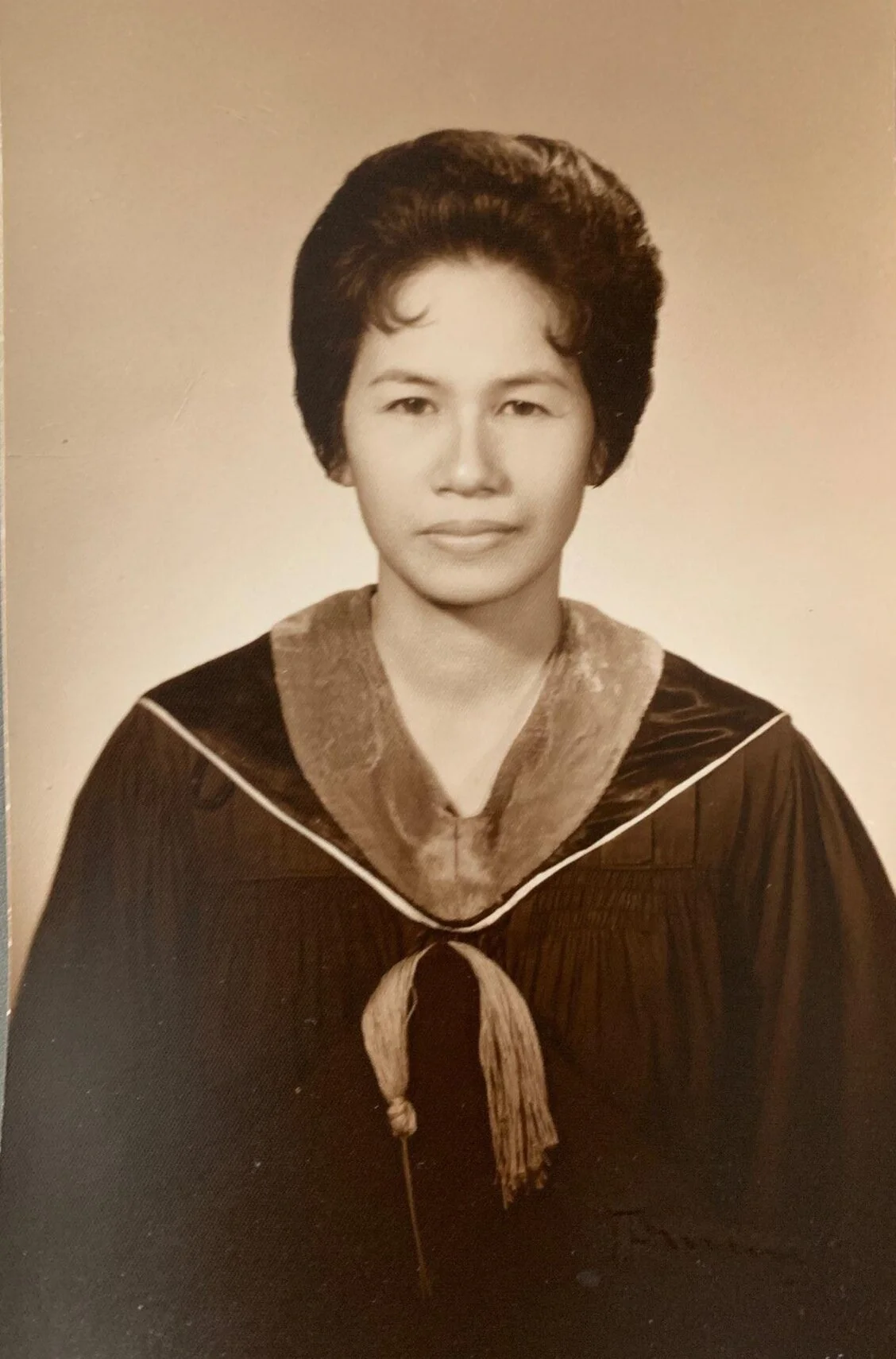
Mama Rosie, my Dad’s Mom. When she graduated with a B.S. in Nursing. Age 22.
My older brother was born in Flint, but they wanted to escape the snowy winters (I don’t blame them!), so they moved to Los Angeles, CA in 1979. My brother was 2 years old at the time. My sister and I were both born in L.A.
My family lived in a city called Lomita. The memories I have from that time are a blur, but I do remember living in a pretty diverse neighborhood. Los Angeles has always been one of the most multicultural cities in the U.S., so it was common to be in community with people of different ethnicities. We were surrounded by Filipino, Latino, Black, Hispanic, Ethiopian, Vietnamese, Russian, and Chinese people. We were exposed to so many kinds of cultural foods and languages. I definitely took easy access to such diversity for granted.
My Dad’s parents lived near us, and we would visit them every weekend. As children, we were expected to uphold family traditions and virtues. The ways we showed respect, the way we gathered, how we talked, ate and carried ourselves was “Filipino” through and through. I regularly heard Tagalog and the Filipino accent. It was normal for my parents and relatives to switch between Tagalog and English, and weekends were always loud and busy. Gatherings involved pot lucks, Tagalog soap operas on TV , and Mahjong tiles clicking around the poker table. My Mama Rosie would play this game with her friends for hours. We would end the night by packing several tupperware containers with leftovers to take home.
Then, we made our first big move.

Ate (Sister) and me.
When I was 5 years old, my family packed up our van, and drove to Lynnwood, WA, a city just 20 minutes north of Seattle. I was too young to notice the heaviness of the transition, but old enough to experience my own sort of culture shock.
Being devout Catholics at the time, my parents enrolled me in Catholic school from 1st grade to 8th grade. There was only one other Asian person in my class and a majority of my classmates and teachers were White. This was much different than my Pre-school and Kindergarten class back in L.A. There were several other Asian-American families in the cul-de-sac we lived in, but as I got older, my closest friends were primarily White as well.
Side note: I adored my childhood friends, and I still do! They helped me survive my awkward Elementary and Jr. High years. My closest friends taught me so much about kindness and acceptance.
When people would say, “Viv, you’re so White-washed, or you’re so White,” I actually thought it made sense. I mostly heard it from people I didn’t really hang with, but accepted it because of the people I chose to be friends with. I agreed with the term because I didn’t know any better, I was too young to know how to argue. I did, however, feel the pain from that label. They were basically saying I was less Filipino because of my actions and the color of my skin didn’t really matter. So as a young, vulnerable girl, I agreed with that identity to fit in. The problem was, I didn’t feel like I fit in with Filipinos who seemed to be “more” Filipino than me. White people called me White-washed, but what hurt more was when Filipinos called me that too. I didn’t feel accepted by my own race. It’s a difficult thing to explain. While my Asian heritage defines a big part of me, I felt guilty for how I was turning out.

Good ol’ church friends! Also, I wore that Adidas jacket everywhere. I wish I still had it.
All through High School, I worked to blend in to feel a sense of belonging. When I had the choice, I refused to learn Tagalog. I would roll my eyes when my Dad made me call my brother Kuya or my sister Ate. I would tease Filipino pop-culture when I saw it on TV, and think it was inferior to American pop-culture. I would even tease my sister for being the more Filipino one! I judged her the same way others judged me. I would embrace family parties at home, but I didn’t appreciate the richness of my tribe when others challenged my skin color. You could say I was just being immature, but there was a part of me that dishonored my ethnicity because I wanted others to accept me.
I took my first trip to the Philippines after I graduated from High School with my Tita (auntie), Mom, and sister. It was an A-MAZ-ING trip, but it also made me feel even more out of place. As a way to prepare me, my Tita said “The locals will be able to tell that you’re an American right away.” For one, I couldn’t speak a lick of Tagalog, and I figured it was because of my overall presence. I wanted so badly to identify as a “true” Filipino. I wanted to blend in and be part of the majority. Yet again, I felt like a minority, even in the Philippines. It didn’t stop me from enjoying all that Manila had to offer. I loved the courteous greetings, like being called Ma’am whenever I entered a store. I was in awe of the never-ending food tours. I loved hearing the sound of jeepneys crowding the city streets, people playing billiards in open garages, and the Filipino pride you could easily absorb. One of my favorite memories from our trip was driving to a different province to visit some relatives. On the way, we stopped to pick up some warm pandesal (salty bread) and queso from a street vendor. We ate it for breakfast in the van. I can still taste the sweet and salty goodness of that snack.
In college, my perspective shifted a bit more. I became more confident of my ethnicity and I would find simple ways to educate others. I gladly welcomed questions like,
“Are both your parents from the Philippines?” [Yes]
”Are you fully Filipino?” [Yes]
“Do you speak Tagalog?” [No]
”Were you born in the Philippines?” [Nope! L.A.]
Rather than take offense, I saw it as an opportunity to share about my background. I felt seen when others asked genuine questions. It was better than assuming things about me.

Now, 15 years after graduating, I’m a mother and my attitude has changed from confusion to ownership. When I was pregnant, I wondered what attributes I would pass down to my own child. I started to grieve the loss of not knowing Tagalog. I grieved living so far away from my parents, siblings, and relatives. We literally live on opposite sides of the country! Amidst that grief, I also saw an invitation. My son Amos is half-Filipino, half-White, and he won’t know anything about his heritage unless my husband and I teach him. That thought pushed me to learn my Filipino history and celebrate it like never before. I may not be able to teach Amos the language, but I can read Tagalog-English books to him. I can ask my parents about their past, and share what I learn. I can teach Amos the signs of respect and the terms we use to honor the generation of aunties, uncles, and grandparents who came before us. I can take him to the Philippines and show him where he came from.
When Amos was born, I really wanted my family and relatives to meet him all together. In a small way, I wanted him to experience the same thing I experienced as kid at my grandparent’s house. So for Amos’ first birthday, we traveled to California to celebrate with my family. The scene below depicts how important this celebration was to me. It wasn’t just a milestone in Amos’ life, but an event he can look back on and say, “These people are my heritage too.”

Now I know the word “White-washed” is an ignorant and, dare I say, racist term. The people who said it judged the color of my skin and thought it didn’t match my characteristics. People didn’t know the weight of their words, they didn’t know me. Now, I know me.
I’m not resentful towards anyone who called me White. If anything, I’m grateful to all the voices that contributed to my process. The greatest gift I can give to my son is to embrace my own identity and teach him to celebrate his own mixed ethnicity. I can teach Amos to see people, to ask questions, and to learn who they are, rather than making assumptions based on the color of their skin. I can to teach him to respect people who are different from him. I don’t have to bring the doubts I had about my ethnic identity into my family’s future. I will not bring the hurtful words spoken over me into my future. I will celebrate differences and learn. I will be acceptance, love, and kindness to others.
“I will not bring the hurtful words spoken over me into my future.”
I’m not less Filipino because of my behavior or choices, and I’m not less American because of my brown skin. I am both, fully Filipino, fully American. That’s the beauty of living in this country. My Filipino heritage and American culture coexist to form the person I am. My diverse background — where I grew up, my friends, my family, my faith, and my values — is what makes me Filipino American.

I also wish I still had this romper.
I’d love to hear your story too! Share your background, your own ethnic identity struggles, or confusing experiences. Our stories help us truly see each other and love the things that make us different. Comment below!